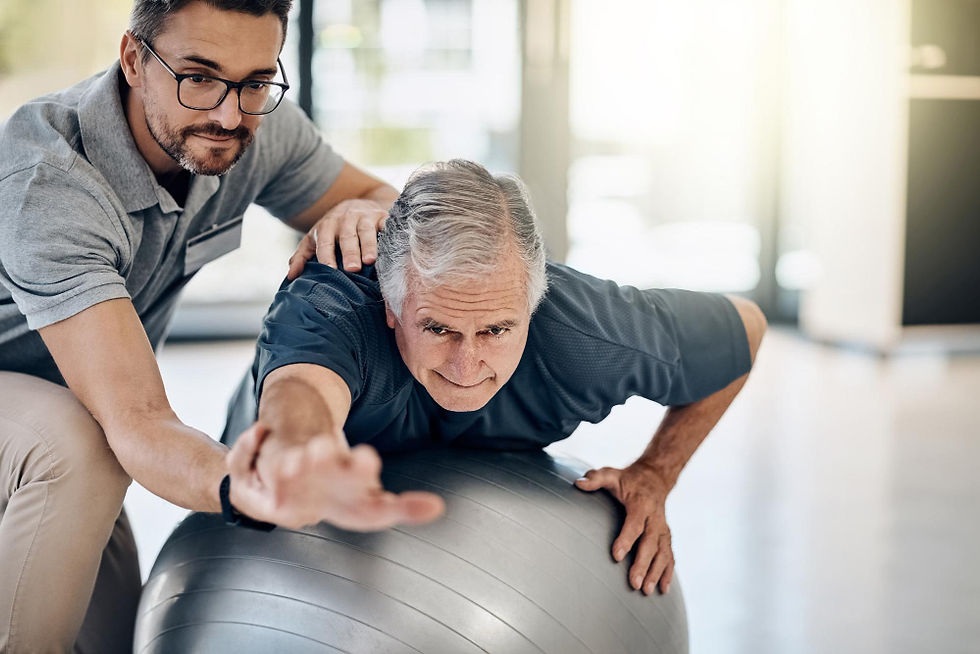
Bridging Education and Practice: How RMR and AFT Work Together to Raise Standards in Rehabilitation
Exercise is now widely recognised as an important part of rehabilitation.
However, as its role grows, so too does the importance of understanding how it is applied — particularly when working with individuals with complex or condition-specific needs.
This raises an important consideration:
➡️ How do we ensure that exercise professionals are equipped not just with skills, but with the understanding required to work safely and effectively in these environments?
At RMR, this has led to a close working relationship with Adaptive Fitness Training (AFT), centred around a shared aim: supporting exercise professionals to develop the knowledge and awareness needed to contribute safely and effectively within rehabilitation.
Why Education and Delivery Need to Be Connected
Within rehabilitation settings, exercise is rarely delivered in isolation.
It sits alongside:
Clinical input
Defined rehabilitation goals
Ongoing monitoring and progression
Multi-disciplinary collaboration
For exercise professionals to contribute effectively, they need more than general training knowledge — they need context.
This is where the link between education and real-world application becomes important.
Without it, there is a risk of:
Inconsistent approaches
Misunderstanding of conditions
Limited confidence when working with complexity
Connecting structured education with practical delivery helps to bridge this gap.
The Role of Condition-Specific Education
General qualifications provide a foundation, but rehabilitation often requires a deeper level of understanding.
Condition-specific education helps to develop:
Awareness of how different conditions affect movement and function
Understanding of common challenges and variability
Confidence in adapting exercise appropriately
Recognition of when to progress, pause, or escalate
This is particularly relevant in neurological conditions, where presentation can vary significantly from one individual to another.
Parkinson’s as an Example
Parkinson’s is a clear example of where condition-specific understanding can make a meaningful difference.
Individuals may experience:
Changes in movement initiation and coordination
Balance and gait challenges
Fatigue and fluctuations in performance
Non-motor symptoms that impact engagement
Exercise can play an important role — but only when it is delivered with an understanding of these factors.
Courses such as the AFT Parkinson’s education programme are designed to support this — helping exercise professionals build both knowledge and confidence in working with the condition.
Importantly, this isn’t about creating specialists overnight.
It’s about raising awareness, improving decision-making, and supporting safer, more appropriate practice.
From Learning to Application
Education alone is not enough.
What matters is how that learning translates into practice.
Through the relationship between RMR and AFT, there is a focus on:
Applying learning within real rehabilitation settings
Reinforcing clear scope of practice
Supporting communication within the wider team
Maintaining consistency across delivery
This creates a more joined-up approach, where education is not separate from practice — but directly informs it.
Raising Standards Across the Sector
The aim is not simply to upskill individual trainers.
It is to contribute to a broader shift towards:
Clearer professional standards
Greater consistency in delivery
Improved confidence across multidisciplinary teams
Better integration within rehabilitation pathways
As more exercise professionals engage with structured, condition-specific education, the overall quality of provision continues to improve.
Supporting a More Informed Approach
This approach supports:
Greater confidence in those delivering exercise-based input
Clearer understanding of capability and limitations
Improved communication across teams
Ultimately, it allows exercise to be used more effectively as part of a wider rehabilitation strategy.
A Collaborative Approach
The relationship between RMR and AFT reflects a shared understanding:
That raising standards is not achieved through delivery alone, or education alone — but through a combination of both.
By connecting structured learning with real-world application, the aim is to support a more consistent, informed, and professional approach to rehabilitation.
Final Thought
As the role of exercise within rehabilitation continues to grow, so too does the importance of getting it right.
By investing in both education and application, there is an opportunity to build a model that not only expands access — but improves quality, safety, and outcomes along the way.